
Chelidonium majus L.
Celandine
Greater celandine is a perennial member of the poppy family (Papaveraceae) rather than a true native — it is an archaeophyte, an ancient introduction thought to have arrived with Roman-era settlement and now thoroughly naturalised. Despite the shared name, it is unrelated to the lesser celandine.
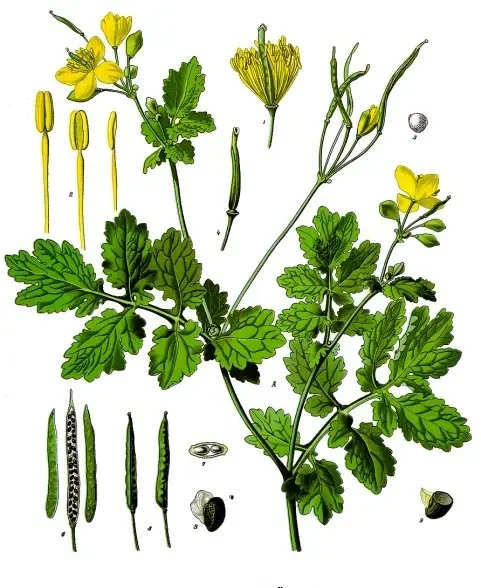
About
Greater celandine is a perennial member of the poppy family (Papaveraceae) rather than a true native — it is an archaeophyte, an ancient introduction thought to have arrived with Roman-era settlement and now thoroughly naturalised. Despite the shared name, it is unrelated to the lesser celandine. Its brittle stems, when snapped, bleed a distinctive orange-yellow latex, and it carries small, four-petalled bright yellow flowers above soft, lobed, slightly bluish foliage.
It is a plant of human company, favouring hedge banks, the foot of walls, roadside verges, waste ground and other disturbed, sheltered spots, usually close to houses and gardens. Flowering is long, from April well into autumn, and the open flowers are visited by hoverflies and bees. The orange sap was historically dabbed on warts, but all parts are poisonous and the latex is an irritant, so it is best valued as an easy-going plant for shady, neglected corners rather than for any home remedy.
Also known as
Great Celandine · Greater Celandine · Nipplewort · Swallow-wort · Swallowwort
Synonyms
Chelidonium cavaleriei · Chelidonium dahuricum · Chelidonium grandiflorum · Chelidonium haematodes · Chelidonium laciniatum · Chelidonium luteum · Chelidonium majus acutilobum · Chelidonium majus claputiense · Chelidonium majus macropetalum · Chelidonium majus majus · Chelidonium majus plenifolium · Chelidonium majus quercifolium
Beta — under active development. This catalogue is still being built and accuracy-checked. The information here (including plant identifications, British native status, soil and sun/shade preferences) is provided in good faith for general guidance only and may contain errors or omissions. It must not be relied upon on its own — please confirm details with us before making planting, specification, foraging or purchasing decisions, and never eat or medicinally use any plant based on this catalogue alone, as some species are toxic. To the extent permitted by law, Phoenix Amenity Supplies accepts no liability for any loss arising from use of this information.