
Carlina vulgaris L.
Carline Thistle
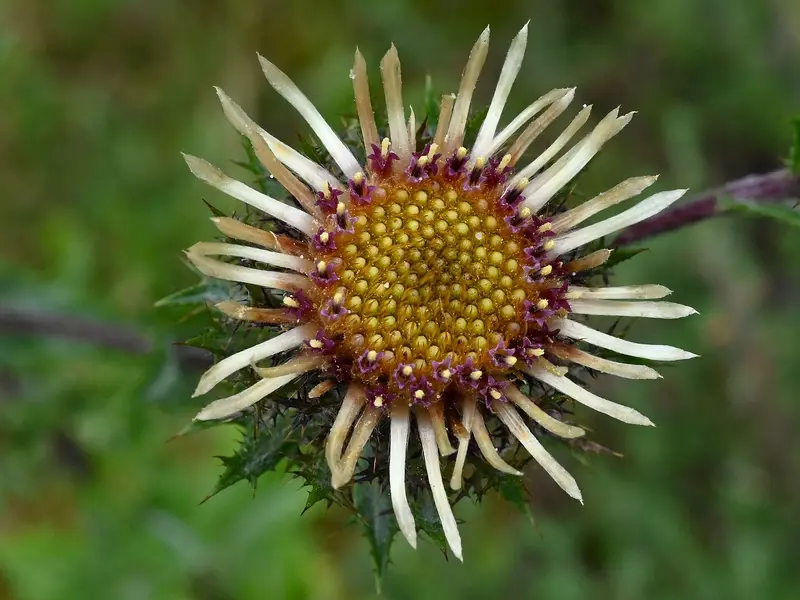
Carline thistle is a distinctive native British biennial of the daisy family, characteristic of dry, infertile, lime-rich grassland, downland, coastal cliffs, sand dunes, quarries and other open, well-grazed places. Low and stiffly branched, it bears spiny, greyish leaves and flat-topped flower heads ringed by spreading, papery, straw-yellow bracts that look like petals but are not; the central florets are brownish.
About
Carline thistle is a distinctive native British biennial of the daisy family, characteristic of dry, infertile, lime-rich grassland, downland, coastal cliffs, sand dunes, quarries and other open, well-grazed places. Low and stiffly branched, it bears spiny, greyish leaves and flat-topped flower heads ringed by spreading, papery, straw-yellow bracts that look like petals but are not; the central florets are brownish. The bracts have a dry, everlasting quality and the dead heads persist through winter, long popular for dried-flower arrangements.
It needs full sun and dry, free-draining calcareous or base-rich soil, and depends on grazing or other disturbance to keep competing vegetation in check. Flowering in mid to late summer, the heads attract bees, butterflies and other insects. A fine choice for calcareous wildflower meadows, dune and chalk grassland restoration and dry, sunny wildlife plantings, it has declined where grassland has been lost or left ungrazed.
Synonyms
Carlina arophila · Carlina corymbosa · Carlina longifolia · Carlina racemosa · Carlina rhodopea plicata · Carlina rhodopea rhodopea · Carlina rigida sordida · Carlina semiamplexicaulis angustifolia · Carlina semiamplexicaulis ramosissima · Carlina semiamplexicaulis semiamplexicaulis · Carlina striata angustifolia
Beta — under active development. This catalogue is still being built and accuracy-checked. The information here (including plant identifications, British native status, soil and sun/shade preferences) is provided in good faith for general guidance only and may contain errors or omissions. It must not be relied upon on its own — please confirm details with us before making planting, specification, foraging or purchasing decisions, and never eat or medicinally use any plant based on this catalogue alone, as some species are toxic. To the extent permitted by law, Phoenix Amenity Supplies accepts no liability for any loss arising from use of this information.